Utility-Scale BESS Enclosures: Service Access, Sealing and Corrosion
Utility-Scale BESS Enclosures: Service Access, Sealing and Corrosion
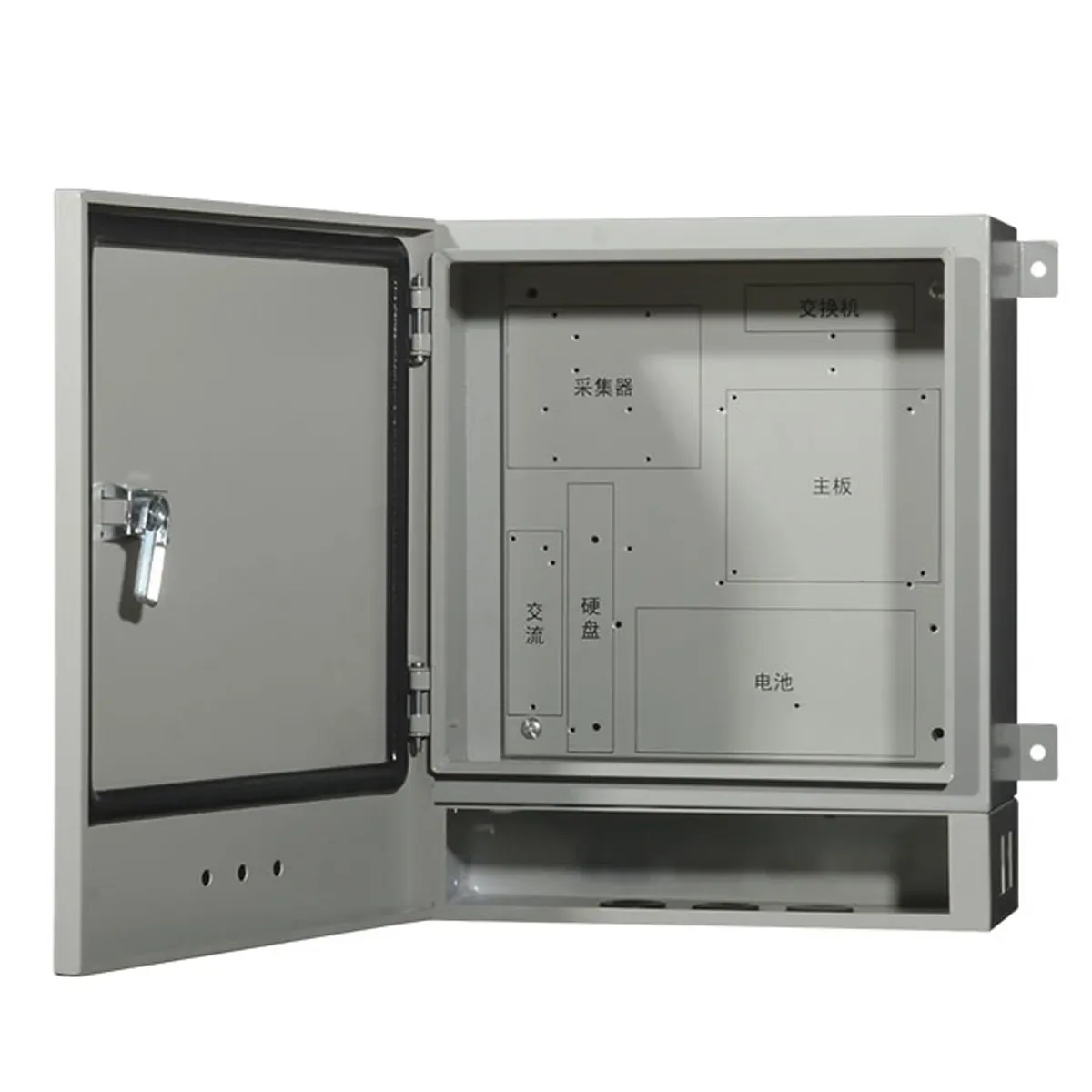
Utility-scale BESS enclosures are designed around a hard trade-off: every opening that makes the equipment serviceable is also a path for water, dust and salt. The workable answer is to separate the enclosure into a sealed weather boundary and an accessible service layer, so maintenance happens behind a gasketed door rather than through the weather seal itself. Fabrication quality on the boundary — flatness, gasket compression, edge protection and drainage — decides whether the enclosure still meets its rating in year fifteen.
What makes utility-scale different from cabinet-scale
A cabinet-scale unit might be opened twice a year. A utility-scale enclosure sits in a switchyard or an open field, is inspected on a scheduled route, and may need a module or a power conversion unit swapped while the rest of the site stays energised. That changes the design priorities:
- Access frequency is high, so doors, hinges and latch hardware see thousands of cycles rather than hundreds.
- Access is partial, so the enclosure needs internal partitioning that lets one bay be opened without exposing the rest.
- Service life is long, commonly 15–25 years, which makes corrosion the dominant long-term failure mode rather than a cosmetic concern.
- Foundations and interfaces are shared, so the enclosure must tolerate the flatness and settlement behaviour of its concrete pad or steel skid.
Planning the access layer
The most common mistake is designing access around the largest component rather than around the maintenance task. A service engineer replacing a filter, reading a gauge or torquing a busbar connection needs a different opening than one removing a unit.
| Access type | Typical opening size | Sealing expectation | Notes |
|---|---|---|---|
| Routine inspection window | 300 × 400 mm | Gasketed, tool-operated latch | Keeps the main door closed |
| Component removal door | 800 × 1,800 mm | Double-lip gasket, multi-point latch | Needs a door retainer to prevent wind slam |
| Roof or top panel | Full bay width | Compressed gasket, bolted | Requires lifting provision and fall protection |
| Cable entry plate | Project-specific | Continuous gasket bead | Usually the hardest penetration to seal |
| Filter or louvre panel | 400 × 400 mm | IP-rated louvre or filter housing | Must drain, not trap, water |
Openings should be positioned so that the door swings away from walkways and so that a fully open door does not block the adjacent bay. On a multi-bay enclosure, this often means alternating hinge sides.
Consider the sequence too: if the design requires a technician to open the weather door to reach a fastener that secures an internal partition, the weather boundary is opened every time that partition is serviced. Putting partition fasteners inside the sealed volume but behind an inner panel keeps the outer gasket untouched.
Sealing details that actually hold a rating
An enclosure rating is an assembly property, not a panel property. A 2 mm sheet with a perfect gasket still leaks if the frame under the gasket is not flat.
Flatness under the gasket line. Gasket compression is proportional to the gap it is filling. For a typical foamed or sponge gasket, a useful working target is a gap variation of no more than about 0.5 mm along the seal line, which in practice means a frame flatness around 1 mm per metre or tighter. Laser-cut and brake-formed frames normally achieve this; frames assembled from several welded segments need checking after welding, because distortion at the weld toes is exactly where leaks start.
Continuous gaskets. Cut gaskets with butt joints at corners are a common leak source. A continuous bead or a moulded corner gasket removes the joint entirely. Where a cut gasket is unavoidable, corner joints should be bonded with the correct adhesive rather than simply butted.
Drainage. Any horizontal seal line needs a path for water to leave. A gasket that sits in a puddle degrades faster than one that sits on a draining sill. Formed sills with a drip edge and a slight outward fall are cheap features that add years of life.
Edge protection. Cable and busbar penetrations that pass through a raw cut edge will chafe insulation. Grommets, edge trim or a formed flange should be specified at every penetration. The sheet metal enclosure page covers the general fabrication approach to these details.
Corrosion protection for outdoor service
Corrosion is usually the reason a BESS enclosure is retired, not electrical failure. The correct protection level depends on the site classification: inland rural, industrial, coastal or offshore. Coating specifications such as ISO 12944 classify environments from C1 to C5, and coastal utility sites commonly fall in the C4–C5 band, where a single-coat paint system is rarely sufficient.
Protection is built from several layers, and each one has a fabrication consequence:
- Substrate choice. Hot-dip galvanised steel is common for structural members and skids. Aluminium is used for weight-sensitive panels. Stainless is reserved for high-chloride or washdown areas.
- Pre-treatment. Galvanised surfaces need a suitable pre-treatment before painting; skipping it is a common cause of premature coating failure on galvanised enclosures.
- Coating system. A typical C4/C5 system uses a primer plus a topcoat and can total 120–240 µm dry film thickness. The number matters: coating thickness is specified and measured, not estimated.
- Cut-edge and weld protection. Coating does not travel into a sheared edge or a weld heat-affected zone the way it covers a flat face. These areas usually need a zinc-rich repair coating or a seam sealant.
- Dissimilar metals. Joining aluminium to steel or stainless to galvanised steel creates a galvanic couple. Isolation washers, barrier tape or a coated interface should be part of the design, not a field fix.
| Environment (ISO 12944 style) | Typical site | Coating approach | Frequent fabrication issue |
|---|---|---|---|
| C2 | Inland, low pollution | Single-coat system | Under-specification after a coastal relocation |
| C3 | Urban or light industrial | Primer plus topcoat | Inconsistent DFT at edges |
| C4 | Industrial or moderate coastal | Multi-coat, higher DFT | Cut edges left unsealed |
| C5 | Severe coastal or offshore | Multi-coat, thick system | Galvanic couples at fasteners |
The small details that decide the outcome
- Fasteners. Coated or stainless fasteners, and a thread treatment that permits removal after several years of weathering. A seized bolt turns a two-hour service into a cutting job.
- Hinges. External hinges with a stainless pin last longer than a welded piano hinge where the weld is the wear surface. Stainless hinge pins in a steel barrel are a classic galvanic pair, so material matching matters.
- Lifting points. Skid-mounted enclosures are lifted and repositioned during installation. Lifting lugs need to be designed into the structure, not bolted on afterwards.
- Label and marking durability. Rating plates and arc-flash labels need a bonded or riveted carrier; adhesive labels on a C5 coating often lift within a few years.
- Internal condensation. Sealed enclosures still breathe through temperature cycling. Breather vents or desiccant provisions belong in the design, and their mounting holes are penetrations that need to be sealed.
Verifying sealing and coating before shipment
Inspection for this class of enclosure usually covers three things: gasket compression traces on the seal line after a door closure test, a coating thickness survey across faces and edges, and a pressure or water test on the assembled boundary. Further detail on the design decisions that interact with these checks is in the energy storage sheet metal component design overview.
It is worth confirming which tests are witness points in the purchase specification. A coating thickness survey done after assembly will find edges and weld repairs that a visual check misses.
Design decisions worth revisiting
- Whether an internal partition can be serviced without breaching the weather boundary.
- Whether the door gasket line sits on a flat, continuous frame or crosses a welded seam.
- Whether every cut edge and weld zone has a defined repair coating.
- Whether dissimilar metal joints are isolated by design.
- Whether the enclosure’s rating is documented for the assembled unit or only for components.
If a project is being placed with an overseas fabricator, the sourcing sheet metal parts from China guide sets out how to structure drawings, inspection and documentation. The custom sheet metal fabrication page gives the wider process view for enclosures built to a project specification.
FAQ
Is IP65 always better than IP54 for a BESS enclosure? No. Higher ratings can trap heat and condensation. The right rating depends on the cooling arrangement and the site environment.
How often should gaskets be replaced? It depends on the gasket material, the UV exposure and the number of door cycles. Scheduled inspection of compression traces is more reliable than a fixed interval.