1
Feasibility and volume review
We assess formability, strip or blank concept, expected annual demand, tolerances, burr direction, and secondary operations.
Checkpoint
Tool concept and cost assumptions are agreed before design starts.
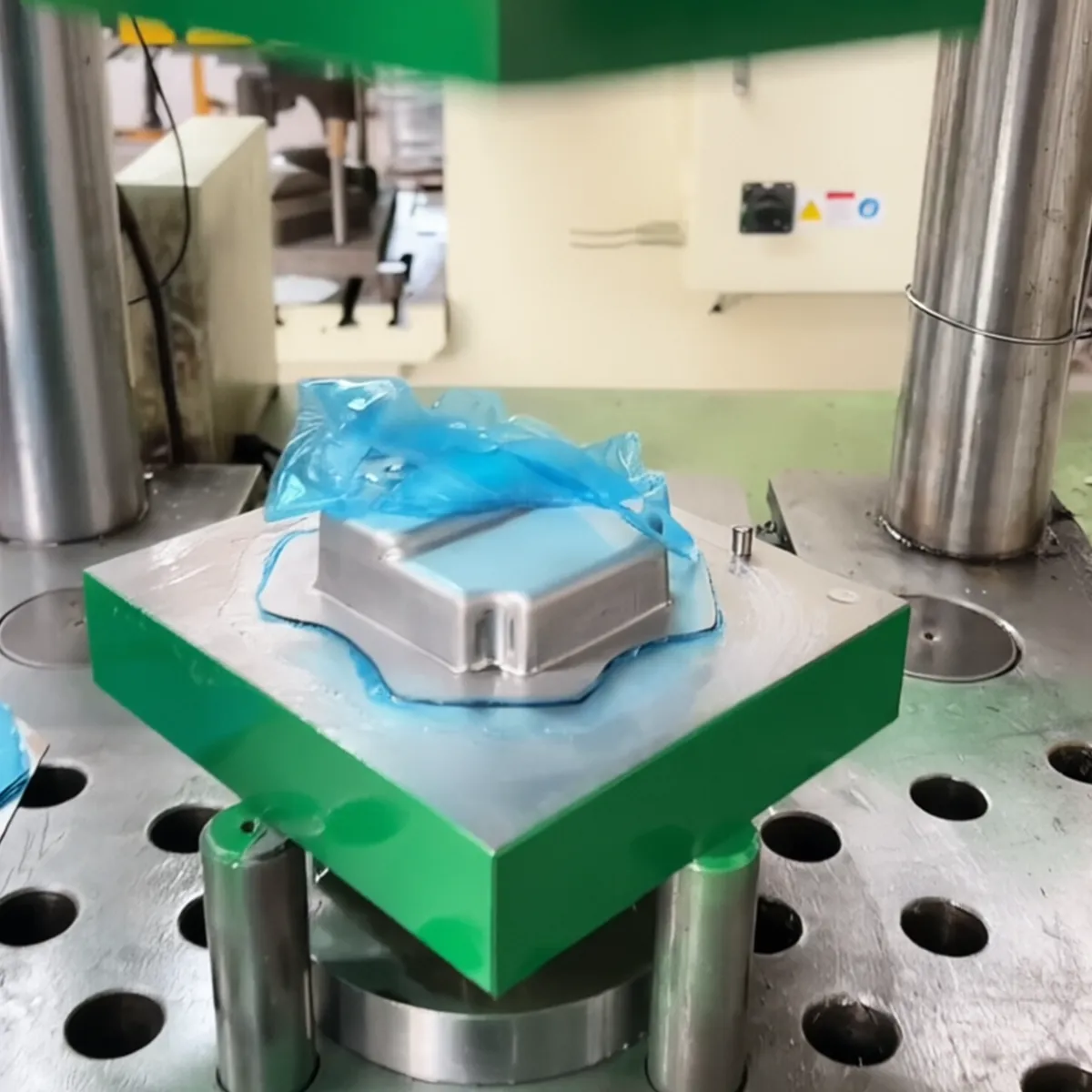
Progressive die stamping, deep drawing, and repeatable forming for production parts from prototype tooling through high-volume runs.
✓ Progressive Dies ✓ Repeatable Forming ✓ Production Scale
In-house factory in Dongguan, China - we fabricate, not just trade
Quality System
ISO 9001
Manufacturing Lead Time
Quoted by Scope
1,500+
Projects Completed
25+
Countries Served
20+
Years Experience
Dongguan
China Factory
Fabex operates certified management systems for quality, environment, and occupational health and safety.
GB/T 19001-2016 quality management system
Environmental management system
Occupational health and safety management system
Tooling-led production
A useful stamping quote connects part geometry and material to tooling strategy, press capacity, validation, maintenance, and expected production volume.
| Capability | Fabex scope | Engineering checkpoint |
|---|---|---|
| Press capacity | Eleven presses — five 110 t, three 250 t and three 400 t. The press is selected from the part, material, tool and forming load rather than from tonnage alone | Nominal tonnage does not define deep-draw or progressive-die feasibility on its own: the tool is checked against bed size, shut height, stroke and the strip and feed line at feasibility, so the press that runs a part is confirmed against the tool rather than assumed from its tonnage. |
| Stamping processes | Progressive, compound and transfer tooling are all run in-house, with the tool concept selected around part geometry, feature sequence and annual volume rather than by preference | Each method carries its own strip layout and maintenance consequence: progressive tooling trades higher tool cost for output, compound tooling suits a single press stroke with fewer stations, and transfer tooling moves the part between stations without a carrier strip. The method is fixed at feasibility because it sets the strip width, feed pitch and press the job runs on. |
| Materials, thickness and typical parts | Cold-rolled low-carbon steel DC01 / DC03 / SPCC 0.4–3.0 mm for brackets, chassis, mounting plates and appliance panels; galvanized SECC / SGCC 0.4–2.5 mm for electrical boxes, enclosures, HVAC parts and outdoor hardware; stainless SUS304 / SUS316L 0.5–4.0 mm for food machinery, marine fittings, heat shields and hygienic parts; aluminium 5052 / 6061 0.6–4.0 mm for electronic casings, heat sinks and lightweight parts; copper, brass and phosphor bronze 0.1–1.5 mm for terminals, busbars, EMI shielding and spring contacts; HSLA and AHSS 1.0–3.0 mm for load-bearing and safety-critical parts | Grade, temper, coating and surface condition are confirmed against the drawing before tool design. These are the grades quoted most often rather than an exclusive list, and the thickness ranges describe the stamping scope for each material family rather than one figure for every process; coil width and feed constraints are agreed with the coil order. |
| Coil feed and strip width | Rated strip width up to 1,600 mm on the coil-fed line, with the common production window at 50–1250 mm and narrow high-speed terminal strip from about 20 mm. The rated width of the feeder must exceed the strip width, leaving margin for camber, edge guidance and threading, so 1,600 mm is the line limit rather than a width that is routinely run. Coils are specified by inner diameter (508 mm or 610 mm), with outer diameter and coil weight confirmed per order; feed pitch is checked against the press crank angle, because the feed, acceleration, deceleration and pilot release must all finish before the die closes | Feed accuracy and attainable stroke rate are confirmed against the press and feeder: a longer pitch reduces strokes per minute, standard servo feed holds roughly ±0.05 to ±0.1 mm in stable running, and thin or high-strength strip needs loop control, camber guides and lower roller pressure to avoid buckle or slip. The quotation states the line and the strip specification it was priced on. |
| Tool ownership and life | Tooling is quoted separately from the part price. Ownership, storage, insurance and transfer rights are recorded in the quotation and purchase agreement before tool design begins, and expected tool life and the maintenance plan are documented with the specific tool | Expected tool life depends on the material, the draw or blank design, and the press it runs on, so it is stated for that tool rather than as a general figure. Maintenance is planned against the production volume and kept with the tool records, because agreeing who is responsible for the tool is what keeps a repeat order predictable. |
| Validation and quality records | First-article inspection is part of the release, not an extra: every first article is inspected before parts leave. Dimensional and inspection reports are available on request, material certificates or datasheets come from our material suppliers on request, and third-party material testing — for example through SGS or a comparable laboratory — can be arranged where the order or your own customer requires it | The submission level, forms, capability evidence, material records and timing are confirmed during quotation, so validation work is planned and priced rather than discovered late. A mandatory certificate standard should be named with the drawing, because that decides which records the order carries. |
Send your drawing, material, quantity, and delivery target. Our team will review the process route, manufacturability risks, and open questions before quotation.
Tooling to production
Tooling cost and lead time are protected by agreeing the part revision, approval samples, quality package, and change process up front.
We assess formability, strip or blank concept, expected annual demand, tolerances, burr direction, and secondary operations.
Checkpoint
Tool concept and cost assumptions are agreed before design starts.
We release the approved part revision into tool design with planned maintenance, sensing, and change provisions.
Checkpoint
Tool design review completed before irreversible build stages.
We run samples, tune the process, measure agreed characteristics, and submit the required approval package.
Checkpoint
Customer approval recorded before production release.
We run under controlled settings, monitor critical features, and maintain the tool against documented wear points.
Checkpoint
Tool and inspection history retained for repeatability.
How we plan your project
See the commercial and engineering checkpoints Fabex uses to move this type of job from drawing review into controlled production.
Application
Drawing-defined sheet metal parts and assemblies
Material
Drawing-specified material and thickness
Quantity
Prototype through repeat production
Lead time
Confirmed after DFM and material review
A repeat-production part required a tooling strategy that balanced investment, feature control, and annual demand.
We confirm the commercial assumptions, review the tool design, approve tryout samples, and retain the maintenance and inspection history.
Documented DFM findings, a proposed manufacturing route, quotation, and lead-time plan for your approval.
Stamping questions
Answers about tooling, ownership, validation, changes, and volume fit.
Stamping becomes attractive when stable geometry and repeat demand justify tooling, especially when multiple features can be formed in a controlled cycle. The decision should compare total program cost, not only piece price.
Ownership, payment milestones, storage, maintenance, insurance, transfer rights, and end-of-life handling should be stated in the quotation and purchase agreement before tool design begins.
Changes are possible, but cost and timing depend on the affected stations, inserts, strip layout, and completed build stage. Engineering changes should be quoted and approved through a controlled revision process.
The team runs sample material, adjusts the tool and process, checks the agreed characteristics, and prepares the required sample or approval documents before production release.
The required submission level, forms, capability evidence, material records, and timing must be confirmed during quotation so the validation work is included in the plan.
Annual demand, batch size, product life, design stability, press rate, material utilization, maintenance, and changeover frequency determine whether simple, compound, or progressive tooling offers the best total program cost.
Yes — pre-coated substrates are quoted where the drawing names them, including zinc–aluminium–magnesium coated steels such as Magnelis S250GD+ZM310 or SGH340D+ZMA275, which are commonly specified for stamped parts exposed outdoors because the coating is designed for edge and formed-surface durability. The coil specification is confirmed before tool design: substrate grade, coating mass and finish, surface condition, and grain. The coating marks more readily than bare steel during handling, so draw radii, blank-holder pressure, lubrication, tool clearance, and burr direction are reviewed at feasibility, and scratch and edge protection through tryout, production, and packing is planned rather than assumed — a coating breach at a stamped edge is where corrosion starts.
Yes, on request. Material certificates or datasheets are supplied from our material vendors when your order, or your own customer, needs the paperwork — they do not accompany every order as standard. If a specific certificate standard is mandatory for your product, say so with the drawing and it will be confirmed in the quotation.
Production stamping DFM
At production volume, strip layout, material flow, forming sequence, burr direction and tool maintenance become part of the product design.
View the complete sheet metal DFM guideReview carrier strength, pitch and nesting before freezing geometry or coil width.
Separate severe draws and bends into practical stages to control thinning, springback and distortion.
Define datums and functional gauges that can be checked consistently throughout the tool life.
Customer feedback
Selected customers
“Fabex support is important to our continued success. Full R&D support makes our cooperation so smooth.”
Tonghua Xiao · Sourcing Manager, Manufacturing Department · Huawei
“It is such a good decision that we went with Fabex for this critical and time-demanding project. We will have projects for you.”
Jessica · Director of Sourcing · Sunglow

“It is amazing how Fabex helped our crazy growth in power and new energy products. Excellent quality, and always delivered on time.”
James Pan · Director of Purchasing · Sinexcel
Production programs, repeat orders and long-term supply.
We keep the approved programs, settings, finish standard and inspection records, so your next order runs to the same specification as the first.
We do not publish a customer's name, product, drawing or project details without written permission. The same discretion applies to your designs.
Send your drawings and requirements for an engineering review, project-specific quotation, and manufacturing plan.