Laundry Appliance Sheet Metal: Drum Housings, Brackets and Coating Durability
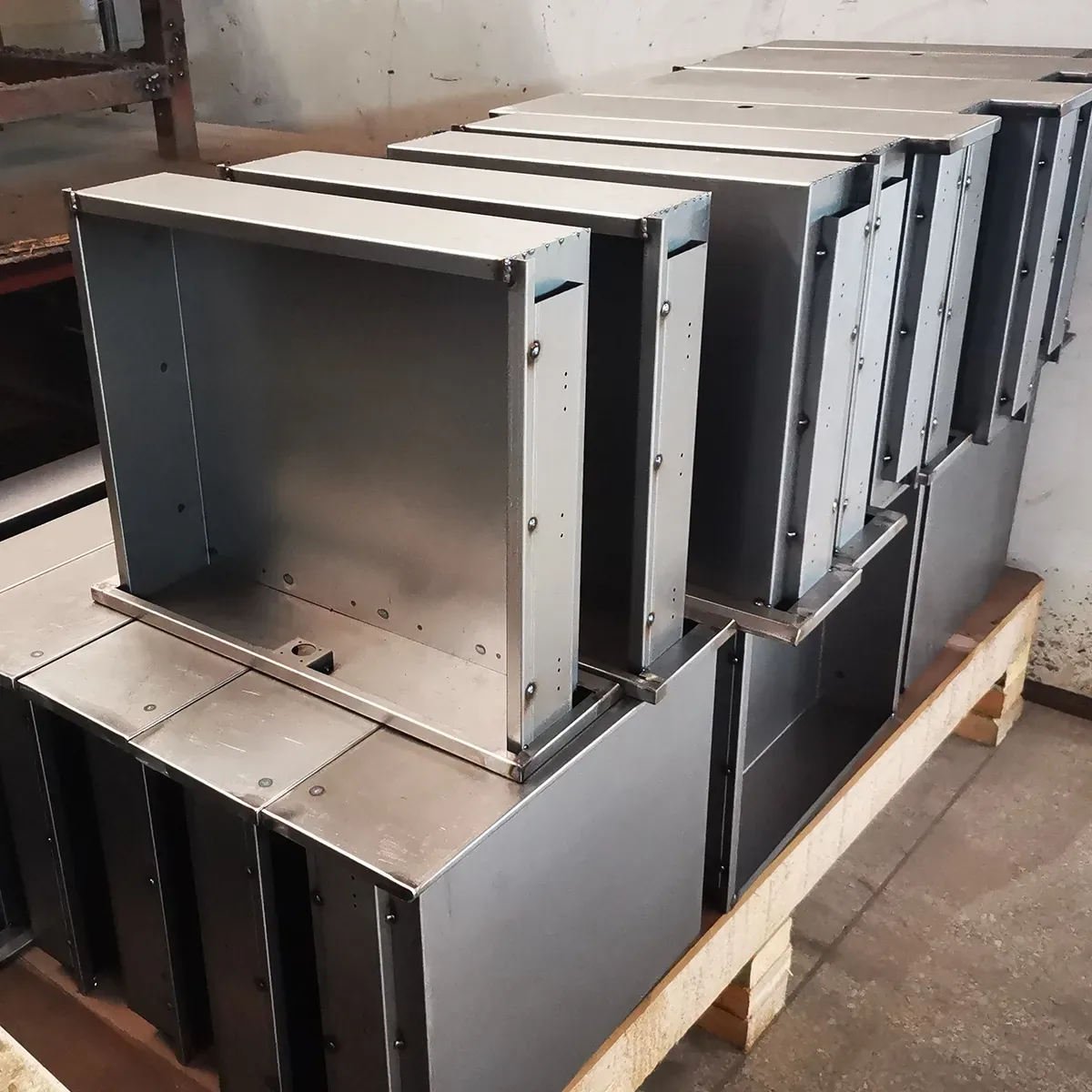
Laundry Appliance Sheet Metal: Drum Housings, Brackets and Coating Durability
Laundry appliance sheet metal has to carry a spinning mass, hold a wet and chemically aggressive environment, and stay quiet enough for an open-plan home — and those three demands pull material and geometry choices in different directions.
The parts that decide whether a washing machine feels solid after five years are the drum support, the cabinet’s structural frame, and the coating system on every cut edge and fastener.
The Load Path From Drum to Floor
Understanding the load path is the fastest way to design brackets that do not need to be made thicker every time the spin speed increases.
In a front-loader, the sequence runs: drum and laundry mass → spider and drum shaft → bearing housing → outer tub or drum support structure → cabinet frame → base plate and feet.
| Stage | Load character | Design consequence |
|---|---|---|
| Drum and wet laundry | Rotating mass with imbalance, up to several hundred newtons of out-of-balance force | Bearings and shaft sized for dynamic load, not static |
| Bearing housing / spider | Concentrated load at three or four arms | Arms must be tied into a stiff ring, not cantilevered from a single face |
| Tub support structure | Distributed load plus vibration isolation | Mount stiffness sets the resonant frequency of the assembly |
| Cabinet frame | Bending and torsion | Corner joints and base plate carry most of the stiffness |
| Base plate and feet | Point loads plus sliding friction | Local reinforcement at feet, corrosion allowance at floor contact |
The engineering aim is to keep the first natural frequency of the suspended assembly comfortably below the spin speed band where it operates, and to damp the band it must pass through. That is a structural problem before it is a sheet metal problem, but the sheet metal design determines how much freedom exists.
Drum Housings and Outer Tubs
Two architectures dominate. A stainless drum inside a plastic outer tub is the common residential arrangement; a stainless drum inside a stainless or enamelled outer tub appears in commercial and heavy-duty machines.
Where the housing is a fabricated metal assembly rather than a moulding, the design points are:
- Circularity. The tub bore must be round enough that the drum does not scrape at the seal or the door bellows. Roundness tolerance should be specified on the bore, not just the diameter.
- Axial alignment. The bearing bore axis and the door opening axis must be concentric within the alignment tolerance, or the door seal is loaded asymmetrically.
- Reinforcement at mount points. Suspension springs and dampers attach at concentrated points. Local doubler plates, formed gussets or welded bosses spread that load into the housing wall.
- Weld or joint quality. Any tub that holds water must be sealed. Seam welds need to be continuous, and the joint design should place the weld where it can be tested.
Brackets: Small Parts With Disproportionate Effect
Cabinet brackets, transport brackets, motor mounts and door-hinge reinforcements generate a large share of warranty noise complaints. A bracket that is stiff enough for the static load can still transmit vibration into a panel that then acts as a speaker.
| Bracket type | Common material | Typical thickness | Design focus |
|---|---|---|---|
| Suspension / damper mount | Cold-reduced steel, galvanised | 1.5–3.0 mm | Fatigue life under reversing load |
| Motor mount | Cold-reduced or HSLA steel | 1.5–2.5 mm | Torque reaction and alignment |
| Door hinge reinforcement | Cold-reduced steel | 1.5–2.5 mm | Local stiffness; avoids door droop |
| Transport bolt bracket | Cold-reduced steel | 2.0–3.0 mm | Single-use removal without cabinet damage |
| Panel stiffener | Galvanised or pre-coated steel | 0.6–1.0 mm | Prevents oil canning and drumbeat |
Two design habits help. First, use formed flanges rather than extra gauge, since stiffness scales strongly with section depth. Second, avoid long, unsupported flat spans in brackets that connect the drum structure to the cabinet, because those spans radiate noise directly.
Corrosion: Where It Actually Starts
Laundry appliances combine water, detergent, fabric softener, heat and dissimilar metals. Corrosion rarely begins on a large flat surface; it begins at edges, holes, fasteners and joints.
The main mechanisms:
- Cut-edge corrosion. On galvanised and pre-coated steel, the cut edge exposes steel. Edge coverage from the coating, or a supplementary edge treatment, decides how long it survives.
- Crevice corrosion. Lapped joints and gasket edges hold detergent residue. Sealing the joint or designing it to drain both help.
- Galvanic corrosion. Stainless fasteners in a galvanised or painted steel bracket create a small galvanic couple. Insulating washers, or choosing a compatible fastener, prevent the accelerated attack at the hole.
- Detergent and softener attack. High-alkaline detergents and quaternary-ammonium softeners attack some coatings and most bare aluminium. Any aluminium component in the wet zone needs a robust barrier.
Coating system selection is therefore a decision about where the part sits: dry zone, splash zone, or permanently wet. Parts in the wet zone usually justify stainless or a properly sealed coating system; dry-zone structure can use standard galvanised or powder-coated steel.
Coating Durability Under Cycles
Accelerated testing is the standard way to compare coating systems, and the interpretation matters as much as the test.
| Test | What it measures | Practical reading |
|---|---|---|
| Neutral salt spray, ISO 9227 | Time to red rust or blistering | Useful for ranking, weakly correlated with real detergent exposure |
| Cyclic corrosion testing | Wet–dry–wet cycling with salt | Closer to real service than continuous salt spray |
| Humidity, ISO 6270 | Blistering and adhesion under condensation | Detects coating porosity and edge defects |
| Adhesion, cross-cut or pull-off | Bond between coating and substrate | Drops sharply if pre-treatment is inconsistent |
| Impact and Erichsen cupping | Coating flexibility | Predicts cracking at formed features and bend lines |
| Detergent and softener immersion | Chemical resistance | The test that matches the application most closely |
Salt spray hours should not be used as the only acceptance criterion for a laundry part. A coating that lasts 500 hours in salt spray but blisters after twenty detergent cycles is the wrong system for that location.
Across the wider product range, the comparative behaviour of powder, wet paint and anodising is set out in the finishing method comparison, and the process detail for each route is described in the sheet metal finishing services overview.
Forming, Joints and the Noise Problem
Noise is a structural issue in laundry products. Design decisions that reduce it also tend to reduce cost:
- Stiffen large panels. Drumbeat noise comes from unsupported panel area vibrating. Beads, ribs and flanged edges raise the panel’s natural frequency above the excitation band.
- Break the direct path. Rubber or elastomeric isolators between the drum assembly and the cabinet remove the solid transmission path. Where isolation is impossible, mass and damping help.
- Avoid rattling joints. Riveted and spot-welded joints that are not tight will buzz. Design joints to be loaded, not merely connected.
- Control gaps at doors and dispensers. Air gaps leak noise as effectively as they leak water.
- Consider the base. Feet, transport bolts and levelling hardware all transmit vibration to the floor, which then acts as a sounding board.
Cabinet and Cosmetic Parts
The visible cabinet is usually pre-coated or powder-coated steel, and its flatness matters because appliance buyers assess it visually under directional light in a showroom.
- Pre-coated steel avoids a separate painting operation but requires protective film and non-marking tooling throughout.
- Formed features near the edges — a folded flange or a shallow bead — remove the drumbeat look more cheaply than increasing gauge.
- Colour consistency across cabinet panels, door and control fascia is a batch-control issue, not only a formulation issue.
What To Specify and Verify
For a laundry programme, the drawing set should state:
- Material grade and coating system per zone (dry, splash, wet).
- Roundness and concentricity tolerances on any water-holding housing.
- Joint requirements, including which joints must be water-tight.
- Coating thickness ranges and the adhesion test method.
- Fastener material and any isolation requirement.
- Noise-critical panels identified so stiffening features are not value-engineered out.
Verification follows the same pattern as other appliance parts, with limits taken from the sheet metal tolerances guide, and the appliance-specific design context is covered in the washing machine component design considerations article. Candidate materials are compared in the home appliance sheet metal material selection guide.
Overall, the parts that survive a decade of laundry duty are the ones designed with the load path, the wet zone and the noise path all drawn on the same sketch. Reviewing that sketch against the sheet metal DFM checklist before release usually identifies cheap structural fixes for expensive field failures. The full range of home appliance sheet metal parts shows how these families are grouped for a production programme.