Battery Energy Storage Cabinet Fabrication: Thermal Paths and Fire Separation
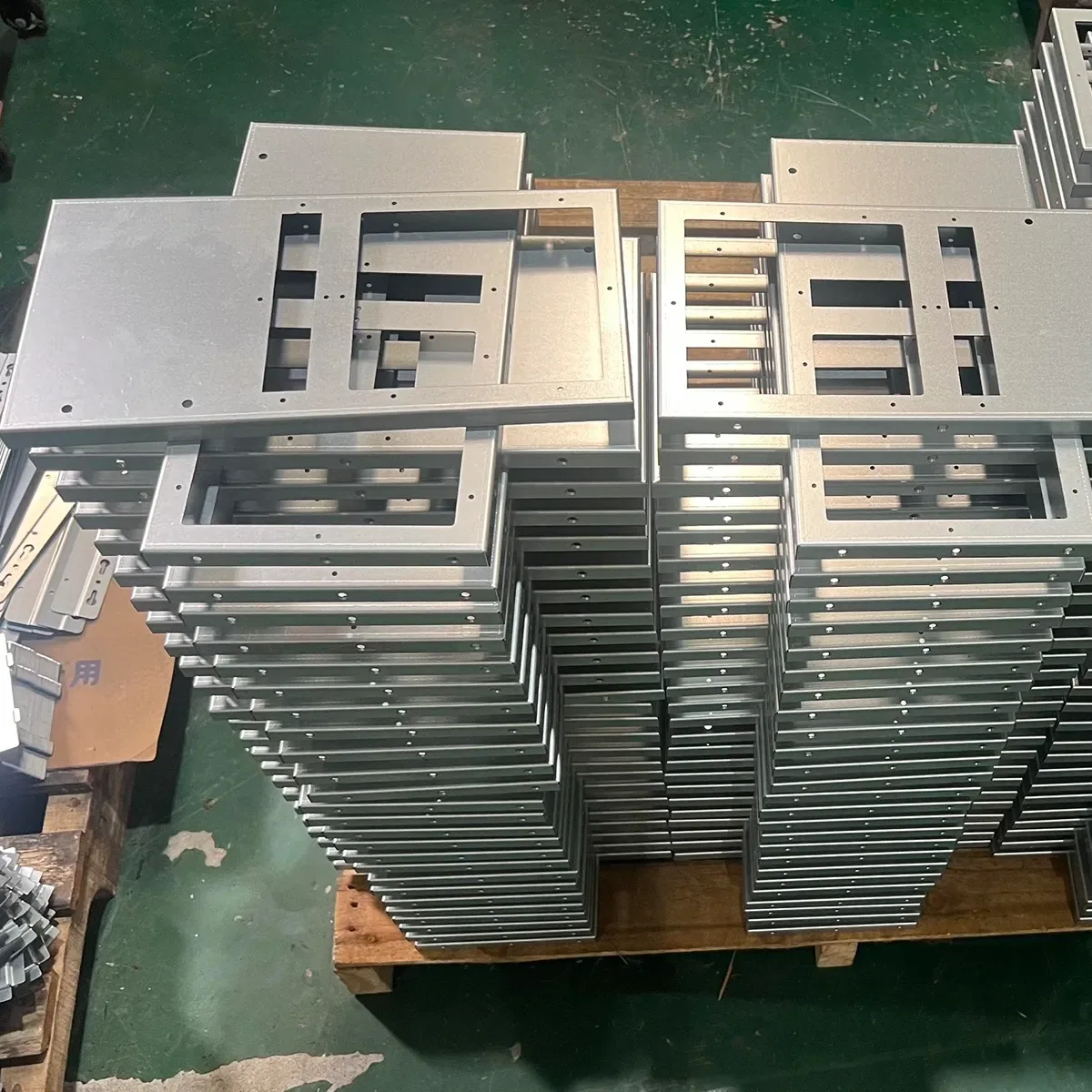
Battery Energy Storage Cabinet Fabrication: Thermal Paths and Fire Separation
A battery energy storage cabinet works only when its sheet metal does two opposite jobs at once: it must conduct heat away from the cells, and it must stop fire and hot gas from reaching whatever sits alongside it. Fabrication decides which of those two wins, because the same wall, the same vent and the same gasket either move energy or block it. The design answer is to split the cabinet into a thermal domain and a containment domain, then let the sheet metal structure serve each domain with different features instead of asking one panel to do both.
The two-domain rule
Most cabinet failures at the design stage come from treating the enclosure as a single sealed box with a fan bolted to it. In practice, cabinets that behave predictably separate the problem:
- Thermal domain — cell surfaces, module bases, busbars, the air path across them, and the heat exchanger or chiller loop that absorbs what the air picks up.
- Containment domain — the boundary that must survive a cell venting event: the compartment walls, the lid, the door, the cable gland plate, and every penetration through them.
Where these domains overlap is the interesting part. A vent that exhausts hot air is also a hole in the containment boundary. A cabinet wall that acts as a heat sink is also a fire barrier. Fabrication tolerances and material choices are what keep the overlap manageable.
Materials and what each one buys you
Cabinet sheet metal is usually selected on three axes: structural stiffness, thermal conductivity, and behaviour under heat. Cold-rolled or hot-dip galvanised steel dominates the structural work. Aluminium appears where weight or conductivity matters more than cost, typically for internal module supports and heat spreaders rather than the outer boundary.
| Function | Common material | Typical thickness | Why it is chosen |
|---|---|---|---|
| Outer cabinet shell | Galvanised steel | 1.5–2.5 mm | Stiffness, cost, corrosion resistance at cut edges |
| Internal compartment walls | Galvanised or mild steel | 1.2–2.0 mm | Fire barrier mass with weldable seams |
| Module support trays | Aluminium 5052/6061 | 2.0–3.0 mm | Weight reduction, local heat spreading |
| Heat spreader plates | Aluminium 6061 | 3.0–6.0 mm | High thermal conductivity, machinable interfaces |
| Door and access panels | Galvanised steel | 1.5–2.0 mm | Flatness, hinge and latch load paths |
| Cable gland plates | Mild steel or stainless | 2.0–3.0 mm | Threaded fasteners, repeated removal |
Thicknesses are indicative. The real driver is the deflection limit under the load case you actually have — a stack of modules, a wind load on an outdoor cabinet, or a seismic requirement — rather than a nominal figure copied from a previous project.
Stainless steel is worth considering where the cabinet sits in coastal air or in a washdown area. It raises material cost noticeably and changes the welding procedure, but it removes a corrosion mode that otherwise shows up two or three years into service on the door seals and gland plates.
Cutting the thermal path
Heat leaves a cabinet by conduction, convection or radiation, and fabrication influences all three. Conduction depends on metal-to-metal contact area. A module base bolted through a powder-coated tray has an insulating film at the interface; masking the coating away at the contact patch, or using bare aluminium there, can change the local thermal resistance more than adding a larger heat sink would.
Convection depends on the air path. Cabinets commonly use one of three arrangements:
- Front-to-back horizontal flow — short path, easy to seal at the sides, but uneven temperatures between the top and bottom modules.
- Bottom-to-top chimney flow — uses buoyancy, suits passively cooled cabinets, and tends to equalise module temperatures better.
- Closed-loop with an internal heat exchanger — the cabinet stays sealed and a liquid loop or air-to-air exchanger dumps heat outside. This is the arrangement that most cleanly separates thermal from containment, because the boundary is never opened for airflow.
For any of these, the fabrication detail that matters is the duct. Formed ducts welded or riveted to the cabinet frame need to be dimensioned against the fan curve, not against the available space. A duct that is 20 percent undersized in cross-section raises static pressure and cuts flow, and the cabinet runs hotter than the thermal model predicted.
Designing the fire separation boundary
Fire separation is a containment problem, and sheet metal containment is about seams, penetrations and pressure relief more than about wall thickness alone.
Seams. A continuous weld is the most reliable boundary. Where a seam is spot welded or riveted, the gap between fasteners is a leakage path for hot gas. Spacing rivets or spot welds more closely near the top of a compartment helps, because that is where gas accumulates. The process detail behind this is covered in the sheet metal welding design guide and the welding and fabrication service pages.
Penetrations. Every cable entry, sensor port and busbar pass-through interrupts the boundary. Gland plates that bolt on with a compressible gasket are serviceable and testable; plates sealed with adhesive are not reworkable. A common industry approach is to specify a continuous gasket bead rather than a cut gasket, so there is no corner joint to leak.
Pressure relief. A sealed compartment that vents will pressurise. Vents or burst panels are usually sized to release gas fast enough to keep internal pressure below the level the door latches and seams can hold. Latch rating, hinge stiffness and vent area belong in the same calculation; specifying them separately is how cabinets pass a component test and fail an assembly test.
Thermal barriers between modules. Intumescent or mineral-based barrier sheets are often sandwiched between modules inside the cabinet. In fabrication terms these need standoffs and edge protection, because a barrier sheet compressed by a module tray loses its thickness and its rating.
A useful comparison of what different boundary strategies cost you in fabrication complexity:
| Boundary strategy | Fabrication complexity | Serviceability | Containment confidence |
|---|---|---|---|
| Fully welded shell, bolted gland plate | Moderate | Low for internal access | High |
| Riveted shell with gasketed seams | Low | Moderate | Depends on seam quality |
| Bolted panels with continuous gaskets | Low | High | Depends on gasket compression control |
| Sealed shell plus internal barrier sheets | High | Moderate | High, if barriers are not compressed |
Tolerances that decide whether it actually seals
Gaskets require controlled compression. If the door frame is bowed, the gasket compresses more at the corners than in the middle, and the middle is where hot gas leaks first. Door frame flatness is commonly held to around 1 mm per metre for this reason. The door and frame are usually a matched pair, and are best kept together through fabrication rather than treated as interchangeable parts.
Hinge axis alignment matters for the same reason. A door that drops 2 mm on opening and closing drags across the gasket and deforms it permanently within a few hundred cycles.
Testing and verification before shipment
Cabinets that rely on sealing are normally checked with a pressure decay or tracer gas test on the assembled boundary, and with a thermal survey under load. The sequence matters: sealing first, thermal second, because a leaking cabinet will not hold a temperature profile. For teams working through the design detail, the sheet metal DFM checklist covers the tolerance and feature decisions that most often need revisiting at this stage.
Where fabrication choices usually go wrong
- Venting the containment compartment directly to atmosphere without a pressure-relief calculation.
- Powder coating the module contact faces and losing the conduction path.
- Using cut gaskets with butt joints at corners instead of a continuous bead.
- Specifying stainless fasteners into aluminium structure without isolating the joint, which invites galvanic corrosion.
- Treating the door and the frame as separately toleranced parts.
None of these are exotic. They are all consequences of deciding thermal and fire requirements in different meetings and reconciling them on the drawing.
Working with a fabricator on BESS cabinets
The most useful thing a fabrication partner can do is ask which domain a change affects: a change that improves airflow and worsens the fire boundary is not a neutral trade. For the usual development sequence, see the battery enclosure fabrication design and safety considerations overview and the custom sheet metal fabrication page. Where a project is placed overseas, the sourcing sheet metal parts from China guide covers documentation and inspection.
FAQ
Does a thicker cabinet wall improve fire performance? Only marginally. Seam continuity, penetration sealing and pressure relief have more influence than adding 0.5 mm to a panel.
Can aluminium be used for the fire boundary? Aluminium melts at a much lower temperature than steel, so it is usually kept to internal thermal parts rather than the containment boundary.
Is passive cooling enough for a cabinet? It can be, if the module spacing, chimney height and vent area are designed together and the duty cycle is modest. Higher duty cycles generally push the design toward closed-loop cooling.