A colour code is not a finish specification
RAL 7035 tells a coater which colour family to reach for. It says nothing about how glossy the film should be, whether the surface is smooth or grained, how thick the film is, or which faces must be left bare. Those are the things a part is accepted or rejected against.
The practical consequence: two parts can carry the same RAL code and still be visibly different on the same machine, which is why a colour reference and a finish specification are two separate lines on a drawing.
Six lines that turn a colour into a coating
- 1. Colour reference — RAL, Pantone or an approved physical sample.
- 2. Gloss — a measured value, not an adjective.
- 3. Texture — smooth, sand, wrinkle or hammer.
- 4. Film build — a target range and where it is measured.
- 5. Masking — threads, earth contacts, mating faces.
- 6. Cosmetic faces — which surfaces are seen, and to what standard.
1. RAL Classic colours in common sheet-metal use
Twenty-six references, grouped the way they are actually chosen. These are not the full RAL range — they are the colours that come up most often on enclosures, cabinets and machine housings.
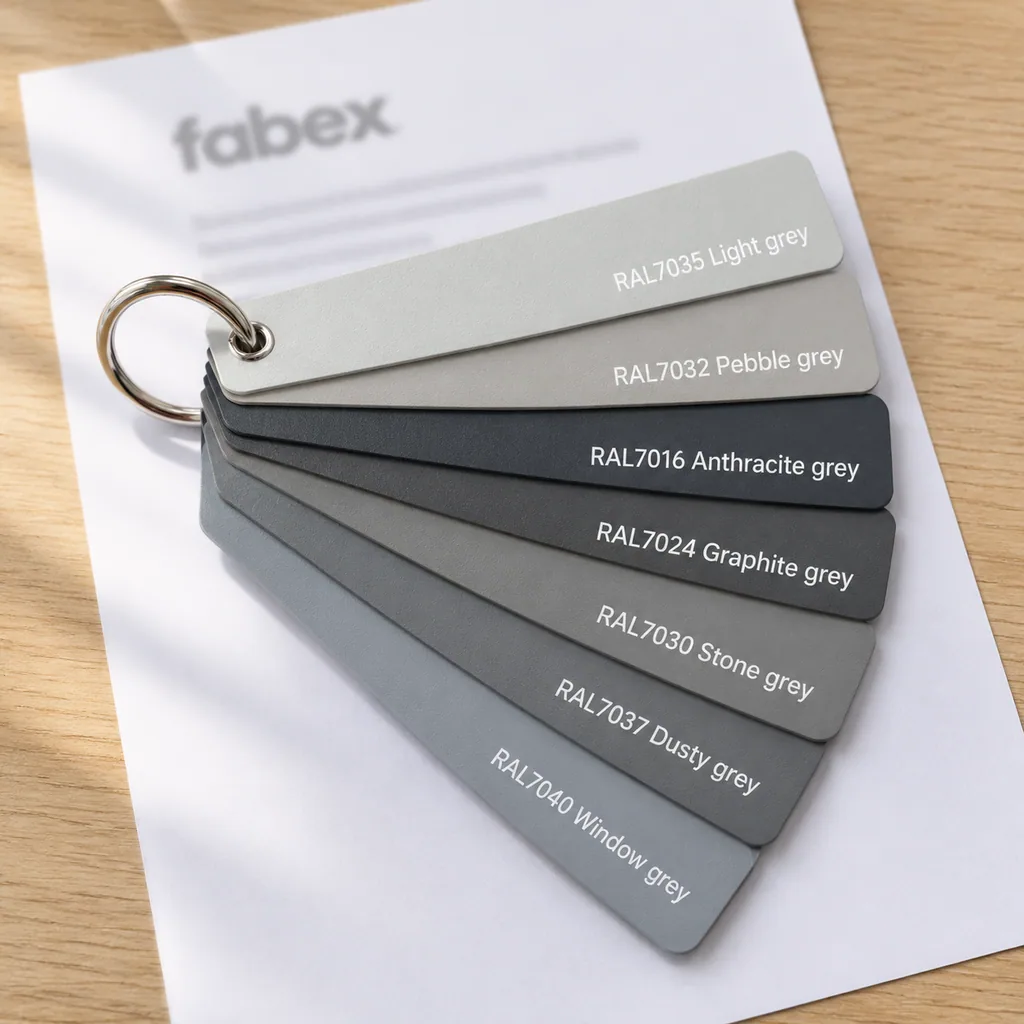
Greys
Most fabricated sheet metal is grey. Enclosures, cabinets and machine housings account for the volume, and the choice between two greys is usually a brand or a legacy decision rather than a technical one.
RAL 7035
Light grey
Electrical enclosures, control cabinets
RAL 7032
Pebble grey
Machine housings, warm industrial greys
RAL 7016
Anthracite grey
Modern casings, trims and door frames
RAL 7024
Graphite grey
Bases, plinths and dark structural parts
RAL 7030
Stone grey
General industrial equipment
RAL 7037
Dusty grey
Neutral housings, muted palettes
RAL 7040
Window grey
Light structural frames and covers
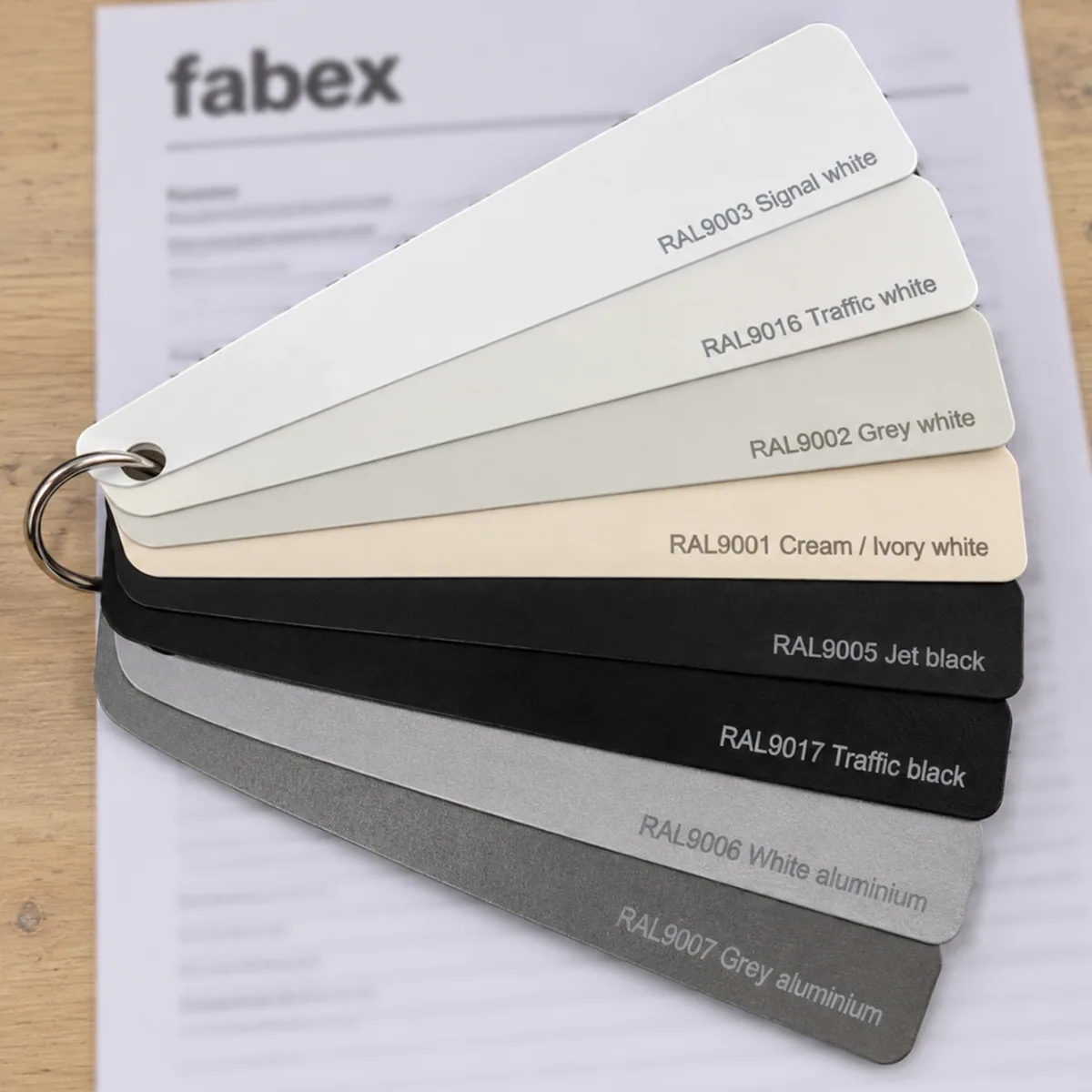
Whites, blacks and metallics
White is the hardest colour to keep clean and the easiest to show a mark. Black shows dust, fingerprints and film-build variation. The two aluminium tones are metallic, so they change with viewing angle.
RAL 9003
Signal white
Clean enclosures, covers and panels
RAL 9016
Traffic white
Bright panels, retail fixtures
RAL 9002
Grey white
Soft white where glare matters
RAL 9001
Cream
Warm off-white, older equipment
RAL 9005
Jet black
Bases, brackets, contrast parts
RAL 9017
Traffic black
Deep black visible panels
RAL 9006
White aluminium
Metallic light finishes
RAL 9007
Grey aluminium
Metallic dark frames
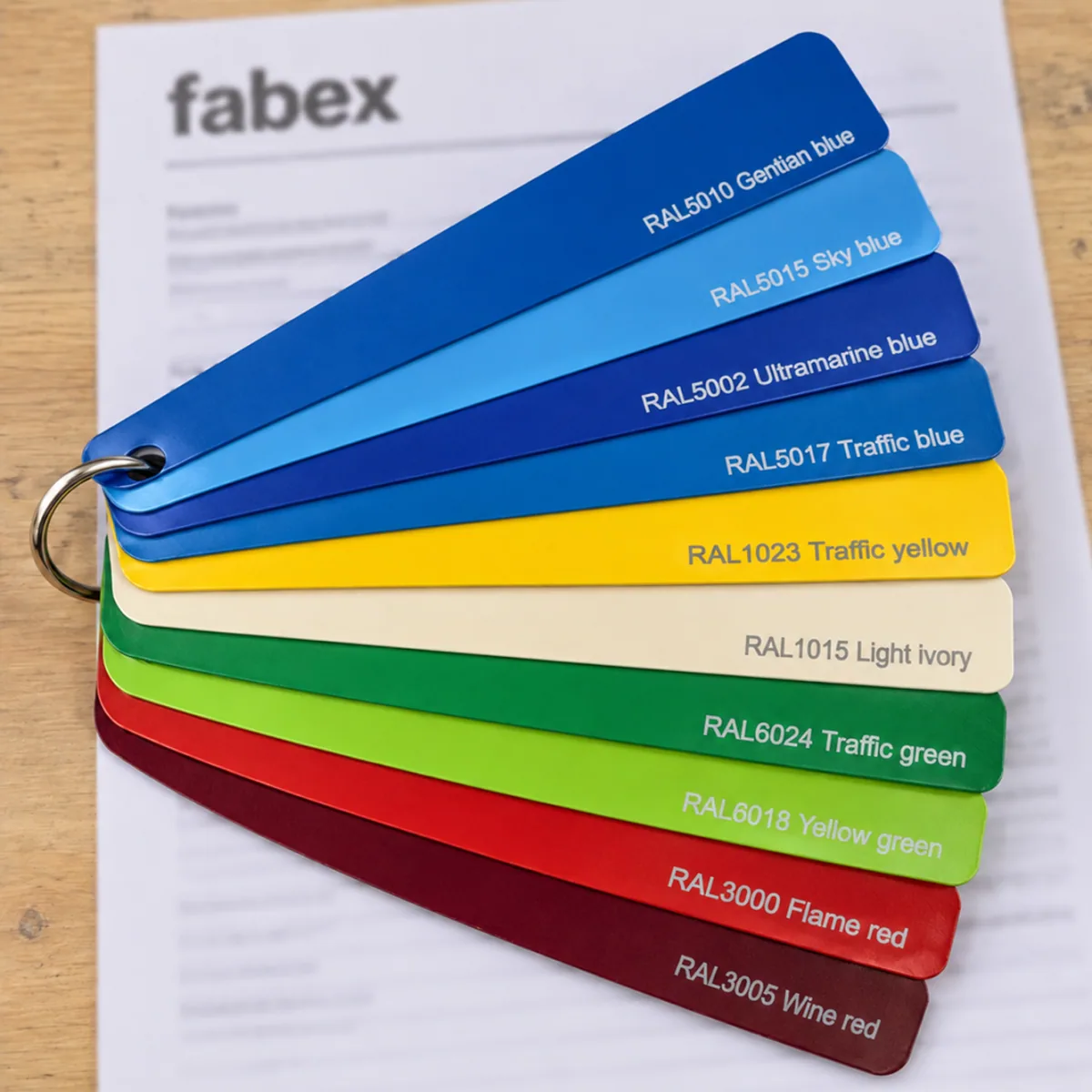
Accent colours
Accents are usually a small area of the part — a panel, a guard, a handle, a safety marker. Each additional colour is a separate powder change and a separate masking decision, so it is worth asking whether it earns its cost.
RAL 5010
Gentian blue
Control panels, machinery accents
RAL 5015
Sky blue
Equipment panels, brand colour
RAL 5002
Ultramarine blue
Deep industrial blue
RAL 5017
Traffic blue
Safety and wayfinding blue
RAL 3020
Traffic red
Safety marking, warning panels
RAL 3000
Flame red
High-visibility enclosures
RAL 3005
Wine red
Dark accent, retail fixtures
RAL 1023
Traffic yellow
Safety warning, lift points
RAL 1015
Light ivory
Classic warm light tone
RAL 6024
Traffic green
Safety indicators, machine controls
RAL 6018
Yellow green
Vibrant accent, retail and signage
On-screen hex values are approximate. They are not a colour specification and will not match a cured powder film. Metallic references such as RAL 9006 and RAL 9007 read as a tone that shifts with viewing angle, which a flat swatch cannot show.
2. Gloss levels, and what the words mean
Gloss is measured, not described. The ranges below are the ones commonly quoted at a 60-degree geometry; the drawing should carry the number and the method, because the adjectives overlap between suppliers.
| Term | Typical 60° units | Where it is used | Watch |
|---|---|---|---|
| Matt / dead flat | under 5 | Machine covers, low-glare panels, anti-glare housings | Hides less. Surface preparation and substrate waviness show through. |
| Matt | roughly 5-20 | Equipment housings, bases, interior brackets | The most common industrial choice, and the most forgiving of surface marks. |
| Satin / semi-gloss | commonly 30-50 | Cabinets, appliance parts, retail fixtures | No fixed number behind the word — agree the measured value. |
| Gloss | commonly 70-90 | Visible panels, covers, branded products | Shows waviness, dents and sanding marks at grazing light. |
| High gloss | above 90 | Retail, appliance fronts, display work | The most demanding on substrate quality and film build uniformity. |
Lower gloss hides more and shows less. Higher gloss reflects more, which is why a gloss part exposes substrate waviness, handling marks and film-build variation that a matt part would absorb. If a part has to look flat, the substrate and preparation matter as much as the powder.
3. Texture and finish terms
A texture is a decision about what the part has to hide, and what it has to look like afterwards. Each one has a cost in touch-up, film build or availability.
Smooth
A flat film; reflections stay unbroken
Used for: Cosmetic faces where the part has to look flat
Watch: Substrate waviness and sanding marks telegraph straight through the film.
Fine texture / fine sand
An even, fine grain across the face
Used for: General industry; a little tolerance for handling marks
Watch: Reads slightly lighter than the same colour in a smooth film.
Sand texture / pebble texture
A pronounced, coarse grain
Used for: Heavy equipment, grip surfaces, parts that get knocked
Watch: Measured film build rises at the peaks; touch-up blends badly.
Orange peel
An undulating, citrus-skin surface
Used for: Usually agreed as a defect limit rather than a look
Watch: Has to be either a specification or an acceptance criterion — never both by accident.
Wrinkle finish
A shrivelled, wrinkled pattern
Used for: Cast or fabricated parts where dents and marks must be masked
Watch: Powder and cure specific, and not available in every colour.
Hammer tone
A hammered, mottled metallic pattern
Used for: Heavy machinery, industrial enclosures
Watch: The pattern follows film thickness, so it varies across a large part.
Stipple
A fine dot pattern
Used for: Decorative parts, non-slip surfaces
Watch: Narrow availability; confirm the powder before the drawing is released.
4. Coating defects an inspector names
A defect description is only useful if it points at a cause someone can control. The right-hand column is what the drawing or the process can actually fix.
| Defect | What you see | Usual cause | What controls it |
|---|---|---|---|
| Sags and runs | A curtain or drip of excess film flowing down a vertical face | Film build above what the powder and geometry allow, or too much powder in one pass | Agree a film build range, and state where it is measured. |
| Fish eyes / cissing | Small round craters where the film pulls away from a point | Silicone, oil mist or compressor oil on the surface or in the air supply | Pre-treatment and compressed-air quality; mask and handle parts cleanly. |
| Pinholes | Tiny holes through the film, often clustered | Outgassing from the substrate or trapped air in a thick film during cure | Degassing of castings and zinc-rich substrates; control film build and ramp the cure. |
| Craters | Depressions larger and shallower than fish eyes | Powder contamination, or incompatible residue from earlier preparation | Powder handling and booth cleanliness; single-source the powder for a batch. |
| Mottling | Uneven, patchy appearance in metallic or pearlescent colours | Flake orientation and uneven film build | Agree a metallic colour on a physical sample, and check it on the real part geometry. |
| Sanding marks | Visible scratches or swirls under the coating | Coarser abrasive than the finish can cover, or skipping a grit step | State the cosmetic faces so preparation is graded to the finish. |
| Overspray | Rough, dry particles on adjacent surfaces | Powder reaching masked or already-coated areas | Masking plan, rack layout and part spacing. |
| Crazing / checking | A fine network of cracks in the film | Internal stress, over-cure, or a film too thick for the powder | Respect the cure window and the maximum film build. |
| Blistering | Raised bubbles under the film | Trapped moisture or gas from preparation or the substrate | Dry-off before coating, and check for contamination under the film. |
| Picture framing | A heavy build-up along folded and cut edges | Powder accumulating at edges and in corners | Edge radius, racking and spray technique; agree how edges are judged. |
| Salt and pepper | A speckled black-and-white effect in metallic colours | Poor flake dispersion, or two powders mixed in the recovery system | Powder lot control and clean recovery. |
| Thin edge coverage | The coating looks lighter, or fails first, on cut edges and bend outside radii | Sharp edges take less film than a flat face | Radius or deburr edges, and state whether edges are a corrosion-critical surface. |
The same surface can be a defect or a specification depending on what was agreed. Orange peel, for example, is an accepted texture on some work and a rejection on others. That is why the acceptance criterion has to exist before the parts are coated.
5. Marks that arrive with the material
Not every mark on a coated part comes from the coating line. These are in the sheet or in the handling, and the finish only makes them more visible.
| Mark | What you see | Where it comes from | What to do about it |
|---|---|---|---|
| Roll mark | A faint repeating line or band from the rolling mill | It is in the sheet, not in the coating | Appearance-critical faces need a material grade and surface condition agreed up front. |
| Brush or linear grain | A directional grain on stainless or aluminium | A deliberate mill or mechanical finish | Grain direction and gloss have to be agreed, and it is often left unpainted. |
| Scratch | A linear gouge or abrasion | Handling damage before coating | It survives the film. Protect faces in handling and packing. |
| Dent | A local depression from impact | Handling or stacking damage | Powder cannot fill it. A texture masks small marks; it does not remove a dent. |
| Oil, rust or scale residue | Patchy adhesion, blistering or early corrosion | Incomplete cleaning or derusting before coating | A defined pre-treatment sequence, not a visual wipe-down. |
6. Colour matching, batches and substrates
Colour is where expectations and process reality most often part company. None of the points below is a fault; they are the normal mechanics of a cured powder film.
- A RAL code identifies a colour standard, not a powder. Two suppliers can both supply RAL 7035 and still differ, so the approved sample is the reference.
- The same powder over cold-rolled steel, aluminium and galvanised steel does not read identically. The substrate tone and the film build both shift the result.
- Film build changes appearance. A light colour over a dark substrate needs enough build to hide it, and a thin film over a bright substrate reads darker.
- Metallic and micaceous colours depend on flake orientation. They are approved on the real part geometry, not on a flat test panel.
- Colour variation between powder lots is normal. Repeat orders should carry the original standard and, where it matters, a retained sample.
- Approval under one light source is not approval under another. Agree the viewing condition, or approve a physical sample in daylight.
7. What to write on the drawing
Eight lines. A quotation can only state what it was given, so anything missing here becomes an assumption that someone else will make for you.
| Item | What to write |
|---|---|
| Colour reference | A RAL Classic code, a Pantone reference, or an approved physical sample with a revision and a date. |
| Gloss | A measured value and method — for example 30 units at 60 degrees — rather than the word "satin". |
| Texture | Smooth, fine sand, coarse sand, wrinkle or hammer tone, stated as a requirement or ruled out. |
| Film build | A target range and the surfaces where it is measured. Edges and corners read higher than flat faces. |
| Substrate and preparation | The material and grade, and the pre-treatment the finish depends on. |
| Masking | Threads, earth or ground contacts, mating faces, hinge lines and any area left bare or conductive. |
| Cosmetic faces | Which surfaces a customer sees, and the acceptance class for them — the reverse side is usually different. |
| Corrosion requirement | The service environment and any test the part must pass, stated separately from the colour. |
Fabex can fabricate, prepare and finish complete sheet metal parts in-house, with automated powder coating for light parts and a wet-paint shop for large or heavy fabrications. Galvanizing, anodizing, passivation, PVD and plating are coordinated as specified processes. See sheet metal surface treatment and finishing for the process side.
Questions about colour, gloss and finish defects
Can I pick a powder coating colour from a screen?+
No. The tiles below are approximate on-screen conversions of RAL Classic references, and a screen is not a colour standard. Use them to shortlist, then approve against a physical RAL fan, a supplier colour chip or a coated sample of your own part.
What is the difference between RAL 7035 and RAL 7032?+
Both are light greys, and both are common on enclosures. RAL 7035 is the cooler, lighter neutral that most electrical cabinets use; RAL 7032 is warmer and slightly greener, and it reads as an older industrial grey. On a large painted panel the difference is obvious, so it is worth confirming rather than assuming.
Is "satin" a specification I can put on a drawing?+
Only as a starting point. Satin, matt and semi-gloss have no fixed numeric meaning across suppliers. A drawing that matters should state a measured gloss value at 60 degrees, the method, and where it is checked — otherwise the supplier and the inspector can both be right and still disagree.
What film build should I specify for powder coating?+
A typical powder build is 60-120 micrometres, and the figure is specification-dependent — the powder, the substrate, the geometry and the corrosion requirement all move it. Specify a target range, state where it is measured, and remember that edges, corners and texture peaks read higher than a flat face.
Does a texture hide dents and weld marks?+
A texture masks fine surface variation and handling marks, which is why it is used on heavy equipment. It does not remove a dent, a scratch or a proud weld. Those are fabrication and preparation issues, and the cheapest place to fix them is before the part is coated.
Can Fabex match a Pantone reference or an existing painted part?+
A Pantone or physical sample can be reviewed and a powder matched to it, but it has to be approved as a physical sample before production — a code alone does not define a cured film. Send the reference, the substrate and the surfaces it applies to with the enquiry, and the match is confirmed with the quotation rather than after coating.
Why did my parts arrive a slightly different colour from the last order?+
Powder is produced in lots, and small differences between lots are normal. The usual causes are a new powder lot, a different substrate or film build, or a different gloss level. If colour continuity across orders matters, say so on the purchase order and keep an approved sample as the reference.
What is the most common RAL colour for electrical enclosures?+
RAL 7035 light grey is the usual answer, and it is close to the light grey most enclosure and switchgear ranges are painted. It is a cool, light neutral that keeps a cabinet readable against a wall and shows less dust than white. RAL 7032 pebble grey and RAL 7030 stone grey are the warm alternatives; RAL 7016 anthracite is the common dark option for modern equipment.
Is RAL 7016 the same as anthracite grey?+
Yes — RAL 7016 is named anthracite grey, and the two terms are used interchangeably in drawings. It is a very dark, slightly blue-grey, and it is the shade most people mean by "anthracite" on window frames and equipment casings. RAL 7024 graphite grey is a step lighter and less blue; the two are easy to confuse on a small swatch and obvious on a large panel.
Can powder coating be touched up on site?+
Small chips can be filled with a touch-up paint or pen, but the repair will not match a cured powder film exactly — the repair is a different product with a different gloss and film build. On visible faces the reliable fix is to recoat the part. This is why the acceptance criteria and the cosmetic faces are worth agreeing before production, and why edges, threads and handling points are worth masking or protecting in transit.
Does powder coating fade or chalk outdoors?+
It can, and the resin decides how much. Polyester powders are the usual choice for exterior work because they hold colour and gloss better under UV; epoxy powders perform well mechanically and chemically but chalk and lose gloss in sunlight, which is why they are specified for interior parts. Coastal salt, industrial atmosphere and strong UV accelerate gloss loss, so state the exposure rather than just the colour.
What gloss level should I choose for outdoor equipment?+
Most outdoor sheet-metal equipment is specified somewhere between matt and satin, in a polyester powder, with the actual gloss measured at 60 degrees. Lower gloss hides substrate waviness and fabrication marks; higher gloss is easier to wipe clean but shows every defect in grazing light. The number on the drawing matters more than the adjective.
How do I match a powder coat to an existing painted part?+
Send the part, or a flat sample of it, rather than a photograph. A match is judged on the substrate, the gloss and the film build together, and the result is approved as a physical sample before production. Where the part is visible next to existing equipment, approve the sample under the same lighting the customer will see it in, and keep it as the standard for repeat orders.
Related reading
- How do you specify powder coating? — colour, gloss, film build and inspection on a drawing.
- Powder coating vs wet painting vs anodizing — which process suits which part and exposure.
- Sheet metal powder coating techniques and applications — what the process does to the part.
- Sheet metal drawing requirements and DFM checklist — the rest of what a drawing has to state.
Ready for Your Custom Sheet Metal Fabrication?
Send your drawings and requirements for an engineering review, project-specific quotation, and manufacturing plan.