Sourcing to European Standards: EN Grades, 3.1 Certificates and the EN 1090 Boundary
Sourcing to European Standards: EN Grades, 3.1 Certificates and the EN 1090 Boundary
European drawings specify two things that are easy to confuse: a product standard for the material, and an execution standard for the fabricated object. The first is routinely satisfiable anywhere. The second is a certification held by a fabricator, and it decides whether a European structural job is a sourcing exercise at all.
Part 1 covered the general substitution decision. This article is the European case — and it contains the one warning in this series worth reading twice: the EN 1090 boundary in the second half.
Standing caution. Cross-references here are procurement directions, not certifications. Every substitution needs the mill certificate and your engineer’s approval before production.
The four EN standards that cover sheet metal
| Standard | Covers | Typical designations |
|---|---|---|
| EN 10130 | cold-rolled low-carbon steel for cold forming | DC01, DC03, DC04 — the general-purpose sheet |
| EN 10346 | continuously hot-dip coated steel flat products | DX51D+Z, S250GD+Z, S280GD+Z, S350GD+Z, and Zn-Al-Mg (ZM/ZMA) |
| EN 10025-2 | non-alloy structural steel | S235JR, S275JR, S355J2 |
| EN 10088-2 | stainless steel sheet and strip | 1.4301 (= 304), 1.4404 (= 316L) |
Aluminium has its own pair — EN 573-3 for the designation (EN AW-5052) and EN 485-2 for the mechanical properties of sheet. Most buyers simply write 5052 and mean the EN AW-5052 family.
EN 10346: the “+” notation is the whole specification
The +Z suffix is the coating, and the number after it is a coating mass in grams per square metre, stated as the total on both surfaces:
| Designation | What the suffix means |
|---|---|
DX51D+Z |
hot-dip zinc coated, multi-purpose grade |
DX52D+Z / DX53D+Z |
progressively better formability (drawing, deep drawing) |
S250GD+Z, S350GD+Z |
structural grades — 250 and 350 MPa minimum yield |
+ZM, +ZMA |
zinc-aluminium-magnesium; e.g. S250GD+ZM310 is the Magnelis family |
+AZ |
aluminium-zinc (55% Al-Zn) |
Chinese stock lists routinely carry DX51D+Z, plain SGCC/SECC at a stated coating mass, and increasingly the ZM/ZMA families. The substitution that works most often is not a name match but a numeric one: a grade whose certificate states the yield and a coating mass equal to Z275 or ZM310 on the same basis.
| EN designation | Practical equivalent family in China | What to confirm |
|---|---|---|
| DC01 | SPCC (JIS) / A1008 CS Type B (US) | drawing quality and elongation, not just chemistry |
| DX51D+Z (Z275) | SGCC with 275 g/m² total coating | coating mass and its basis; zinc-only vs alloy |
| S250GD+Z | ~G300 / Q355 general grades | certified minimum yield |
| S350GD+Z | Q355B, G350-class | certified minimum yield |
| S355J2 | Q355B (GB/T 1591) | impact test requirement — the “J2” is not decoration |
| 1.4301 / 1.4404 | SUS304 / SUS316L | actual nickel and molybdenum content, by certificate |
| EN AW-5052 | 5052 | temper (H32 etc.) and flatness |
S355J2 deserves a note. The J2 means guaranteed impact energy at −20 °C. A Q355B certificate may or may not include Charpy testing; if the design depends on low-temperature toughness, ask for the test result, because “equivalent strength” says nothing about it.
EN 10204 certificates: 2.2 versus 3.1
This is the most common European sourcing question after the grades, and the answer is usually “it depends on what the end customer’s auditor accepts”.
| Certificate | What it is | When it is asked for |
|---|---|---|
| 2.2 | manufacturer’s declaration of compliance with the order, no test results | general industrial parts |
| 3.1 | inspection certificate with the actual test results, issued by the manufacturer’s independent inspection representative | structural, pressure, and work for customers with a supplier quality regime |
| 3.2 | as 3.1, but issued by an independent body designated by the purchaser | rarely, for high-consequence work |
A “mill cert” in a Chinese quotation usually means something at the 2.2 level or a mill’s own test report. It is not automatically a 3.1, and the difference is exactly what a European auditor is checking for: named test results, traceable to the delivery, endorsed independently.
If the end use needs a 3.1, name it with the drawing. Expect it to cost money and time, and expect it to be arranged per order rather than standing. It is a documentary service, not a property of the steel.
The EN 1090 boundary — read this before quoting a structural part
EN 1090-1 is about CE marking of structural steel components placed on the EU construction market. It is not a material standard, and it is not a general “quality certificate” that applies to any sheet metal part.
Three things follow, and they matter commercially:
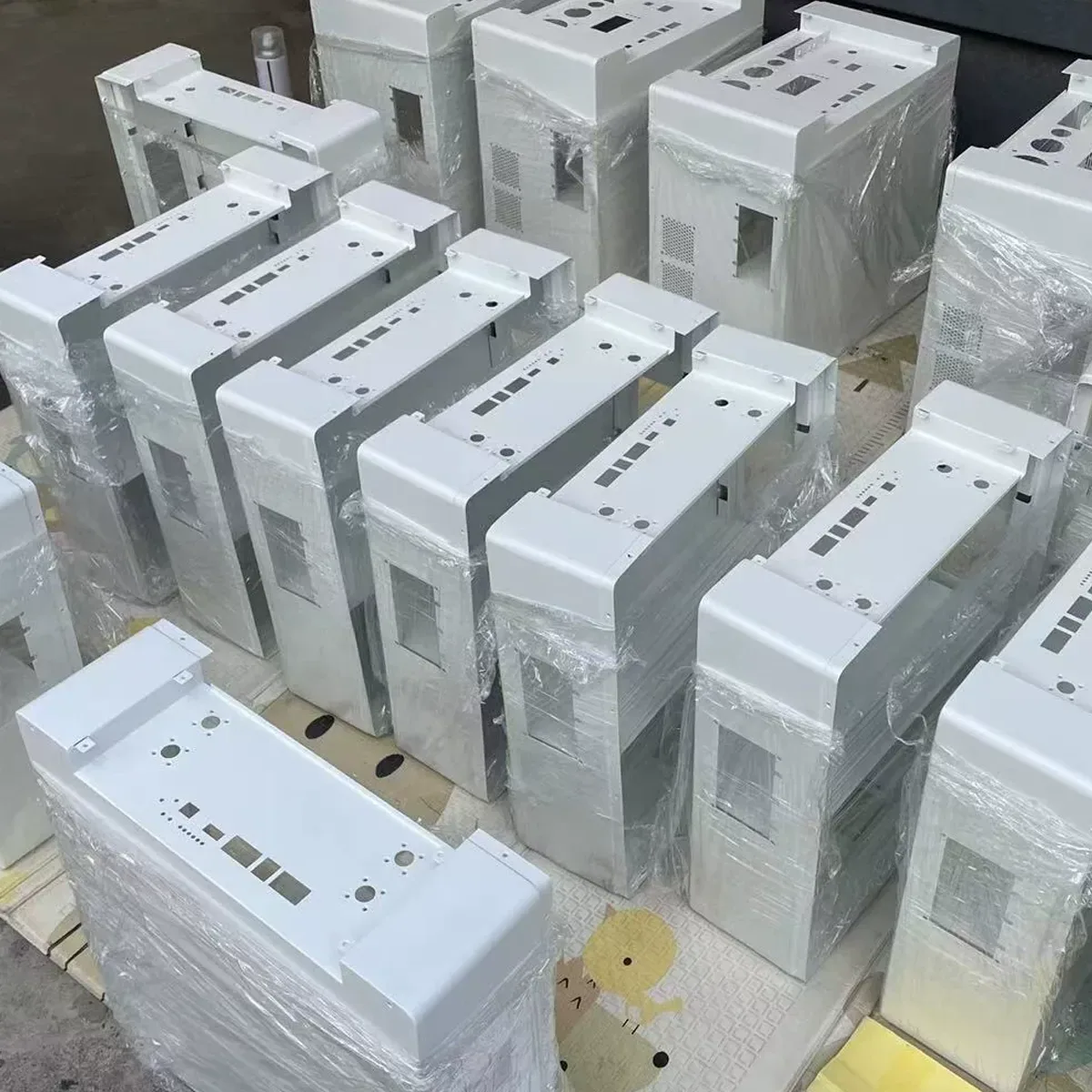
1. Most sheet metal parts are outside its scope. An enclosure, a machine guard, a bracket inside a piece of equipment, a cabinet, a chassis: these are parts of machinery or products, not structural components supplied into construction works. They are governed by the machinery or product directives that apply to the finished equipment, not by EN 1090.
2. Where EN 1090 does apply, it is a fabricator certification. A supplier producing structural steelwork for the EU market needs the relevant execution class (EXC1 to EXC4, defined in EN 1090-2) supported by factory production control and assessment. That is a certification of the producer, not a grade of steel. Buying S355 with a 3.1 certificate does not make a fabricator EN 1090 compliant.
3. CE marking, where it applies, is declared for the component by the party placing it on the market. It is not something a component supplier can attach to a drawing “to be safe”. Asserting CE compliance on a part that has not been through the conformity route is a false claim, and it is the fastest way to fail an audit later.
What this means in practice: if your part is a machined or fabricated component of a machine, a vehicle, an appliance or an enclosure, the relevant route is your product’s conformity process, and the material certificates are inputs to it. If your part is structural steelwork for a building, you need a fabricator holding the right execution class — and that is a supplier-selection question, not a material-substitution question. Say which one you are buying, because the two quotations are not comparable.
Where the sensible substitutions are
For a European drawing at low volume, the pattern is consistent:
- DC01 / DX51D+Z — routine. Match the coating mass numerically and confirm formability grade if the part is deeply formed.
- S250GD / S350GD — routine via Q355/G350-class families, provided the certificate states the yield.
- S355J2 — the strength is easy; the −20 °C impact test is the part to confirm.
- 1.4301 / 1.4404 — no translation needed conceptually, but stainless substitutions fail on composition more often than any other family. Ask for the certificate’s nickel and molybdenum figures; a “304” that is marginal on nickel behaves differently in chloride.
- Zn-Al-Mg (+ZM) — increasingly available and genuinely better at cut edges. If the part is outdoor and the specified grade is a plain zinc class, this is worth raising as an upgrade rather than a substitution.
What to put on the drawing for a European job
- The EN product standard and designation, with coating mass and basis.
- The certificate type — 2.2, 3.1, or third-party test — stated explicitly.
- Whether any part of the assembly is structural, and under which execution class, if so.
- Impact or low-temperature requirements, if the design depends on them.
- Formability grade, if the part is drawn rather than bent.
- Surface and cosmetic class, because European drawings often reference a coating standard that the Chinese supplier will interpret differently.
The summary
Europe is the market where the paperwork is more demanding than the metal. DC01, DX51D+Z, S355 and 1.4301 all have straightforward Chinese equivalents; a 3.1 certificate and an EN 1090 execution class do not appear because you asked for good steel.
The Australian case has the same shape with different names; the US case trades coating classes for ounces per square foot. If you want a European drawing priced with the certification question answered up front, send it over and say what the end customer’s auditor will ask for.